


OsteoSinter® EVANS and COTTON wedges
In words of Leonardo DaVinci, the foot “is a masterpiece of engineering and a work of art”.
In words of Leonardo DaVinci, the foot “is a masterpiece of engineering and a work of art”, but, like any structure subjected to repeated mechanical loads, it can end up having problems.
The around 8,000 steps a day on average that it supports makes it prone over the years to suffer pathologies. It is estimated that more than 80% of the population will suffer health problems of varying severity in the feet at some point in their life.
Among the multiple pathologies that occur, flatfoot deformity (valgus flatfoot of the adult) is one of the most relevant and complex, and continuously changing and innovating.
Surgical treatment of valgus flatfoot rarely requires a single isolated procedure, but rather a selection of techniques. Among these techniques, Evans and Cotton osteotomies occupy an important place.
OsteoSinter® EVANS and COTTON wedges: description and indications
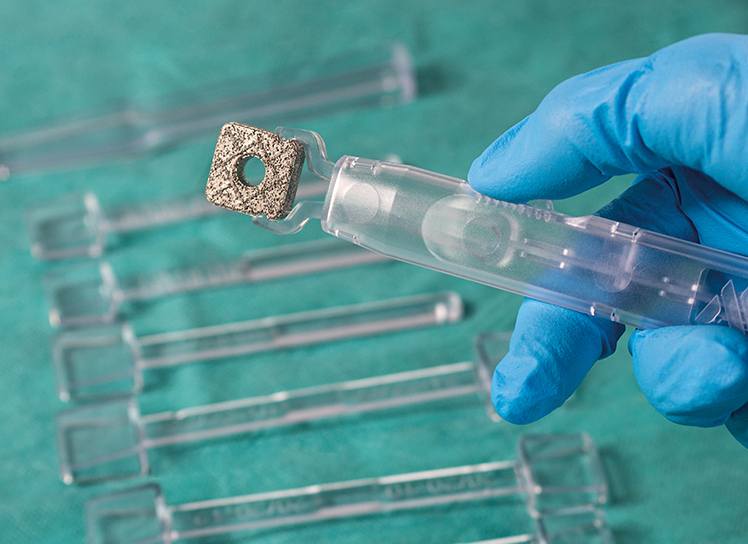
OsteoSinter® EVANS and COTTON wedges are porous titanium implants used to correct adult-acquired flatfoot deformities, specifically for stage II posterior tibial tendon dysfunction.
The wedges are intended to be used as an implant for an EVANS procedure (for lateral column lengthening) or COTTON procedure (to improve the inclination of the first radius and avoid the overloading the external column.)
The implant is intended to be used with the associated instrument kit (made of Polyamide grade 12) in a surgical setting by a medical professional (traumatologist). The product is presented unitarily packed in blister and sterilized with gamma radiation.

The OsteoSinter® material:
Trabecular bone mimicry
Ultraporous pure titanium
The OsteoSinter® material[3] is biocompatible CP Titanium manufactured by means of Powder Metallurgy technology.
A special design of the manufacturing process allows to obtain a product with interconnected porosity (62-66% in volume)[4] , favoring osteointegration of the surrounding bones.
The result is a material that mimics the structure and characteristics of human bone, specially the apparent elastic modulus and the porosity shape.

Trabecular
bone[1]

OsteoSinter®
material[2]
[1] AME19-C015 [2] p00100_osteosinter porosity [3] Patented material [4] p00100_te_medical device
Indications
OsteoSinter® EVANS and COTTON wedges are intended to be used for internal bone fixation of bone fractures, fusions, or osteotomies in the foot. Specific indications include:
- Opening wedge osteotomies of the bones of the foot (including osteotomies for Hallux Valgus).
- Opening wedge of medial cuneiform or Cotton osteotomies.
- Lateral column lengthening (Evans lengthening osteotomy or Calcaneal Z osteotomy).
- Metatarsal/Cuneiform arthrodesis.
OsteoSinter® EVANS and COTTON wedges are indicated for use with ancillary bone fixation.
OsteoSinter® EVANS and COTTON wedges are not indicated for use in the spine.

Contraindications
- Infection
- Physiologically or psychologically inadequate patient (conditions that tend to limit the patient´s ability or willingness to restrict activities or follow post-operative care instructions).
- Inadequate skin, bone or neurovascular conditions.
- Growing patients with open epiphyses.
- Foreign body sensitivity. Where material sensitivity is suspected, testing is to be completed prior to device implantation.
- Patient smoking may result in delayed healing, non-healing and/or compromised stability in or around the placement site.
BENEFITS

Osteointegration
The interconnected porosity of the OsteoSinter® material enables the osteointegration of the surrounding bones.

Primary fixation
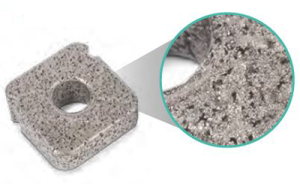
The porous structure of the material and the relief shape of the surfaces provide primary fixation to the bone.

Mechanical properties
The OsteoSinter® material exhibits an elastic mechanical behavior very similar to the human bone.
| Property | Material | |
|---|---|---|
| OsteoSinter®[1,2,3] | Trabecular bone[4,5,6] | |
| Elastic modulus (GPa) | 2.8 | 0.01-3 |
| Compressive yield strength (MPa) | 31 | 0.1-30 |
| Friction coefficient | 1.22 | 0.44-0.63 |
| Compressive fatigue limit | 5 M cycles at > 11.3 MPa without failure | N.D. |
[1] p00100_compressive properties OsteoSinter®
[2] proy180093.
[3] proy220128.
[4] ADVANCE® BIOFOAMTM Cancellous Titanium_Tibial implants_Technical Monograph.
[5] Morgan EF, Unnikrisnan GU, Hussein AI. Bone Mechanical Properties in Healthy and Diseased States. Annu Rev Biomed Eng. 2018 Jun 4;20:119-143. doi: 10.1146/annurev-bioeng-062117-121139. PMID: 29865872; PMCID: PMC6053074.
[6] Shirazi-Adl A1, Danmark M, Paiement G. Experimental determination of frictin characteristics at the trabecular bone/porous-coated metal interface in cementless implants. J Biomed Mater Res. 1993 Feb;27(2): 167-75.

Single-use instruments kit
The OsteoSinter® EVANS and COTTON wedges are placed using a sterile, single-use instrument kit made of Polyamide 12 material.
The Single-use OsteoSinter® EVANS and COTTON instrument kits include:
– A set of sizers (one for each size and type of wedge).
– Tweezers to hold and insert the wedge.
– An impactor to seat the wedge in its implanted position by tapping gently with a standard hammer (not supplied in the kit).
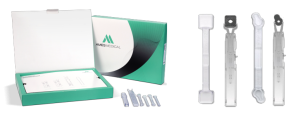
Sizers
-
Replicate the shape of the wedges to select patient´s correction prior to final implant selection.
-
Size identification on the sizer.
Tweezers
-
Allow the user to grab the implant and place it onto the osteotomy site.
SIZES
OsteoSinter® EVANS wedges
12 sizes (3 dimensions with different surfaces and 4 thicknesses for each one)

| Width(mm) [W] | Length(mm) [L] | Height(mm) [H] |
|---|---|---|
| 18 | 18 | 6 |
| 8 | ||
| 10 | ||
| 12 | ||
| 20 | 20 | 6 |
| 8 | ||
| 10 | ||
| 12 | ||
| 22 | 22 | 6 |
| 8 | ||
| 10 | ||
| 12 |
OsteoSinter® COTTON wedges
6 sizes (2 dimensions with different surfaces and 3 thicknesses for each one)

| Length(mm) [L] | Height(mm) [H] |
|---|---|
| 15 | 4.5 |
| 5.5 | |
| 6.5 | |
| 20 | 4.5 |
| 5.5 | |
| 6.5 |
Reduction of healthcare costs
OsteoSinter® EVANS and COTTON wedges are titanium implants and therefore do not present reabsorption issues. The OsteoSinter® EVANS and COTTON wedges and related accessories reduce the surgery time compared to unconfigured allografts, because:
• Simplify pre-operative handling.
• Direct placement, without carving or
on-site adjustment.
• OsteoSinter® EVANS and COTTON wedges and related accessories are provided sterile.


REFERENCES
Haeomatogenous infection
Komnos, G., Banios, K., Kolonia, K., Poultsides, L. A., Petinaki, E., Sarrou, S., Zintzaras, E., Karachalios, T. (2020). Do trabecular metal and cancellous titanium implants reduce the risk of late haematogenous infection? An experimental study in rabbits.
Single-use Orthopedic Instruments
Cook, Dan (2023). Interest in Single-Use Orthopedic Instruments Continues to Grow
Porous Titanium Wedges
Moore, S. H., Carstensen, S. E., Burrus, M. T., Cooper, T., Park, J. S., & Perumal, V. (2018). Porous Titanium Wedges in Lateral Column Lengthening for Adult-Acquired Flatfoot Deformity. Foot & Ankle Specialist, 11(4), 347–356.
Porous Titanium Wedges
Gross, C. E., Huh, J., Gray, J., Demetracopoulos, C., & Nunley, J. A. (2015). Radiographic Outcomes Following Lateral Column Lengthening With a Porous Titanium Wedge. Foot & Ankle International, 36(8), 953–960.
Corrective Osteotomies
Matthews, Michael et al. (2018). Long-Term Outcomes of Corrective Osteotomies Using Porous Titanium Wedges for Flexible Flatfoot Deformity Correction. The Journal of Foot and Ankle Surgery, Volume 57, Issue 5, 924 – 930.
Porous Titanium Wedges
Andrew B. Bridgforth, M. Tyrrell Burrus, Joseph S. Park (2016). Varus Deformity of the Distal Tibia From Physeal Growth Arrest Treated Using a Titanium Metal Porous Wedge. Volume: 9 issue: 5, page(s): 452-456.
titanium metal foam wedge implant
Tucker D (2010)..Lateral column lengthening in adult flatfoot surgery using a titanium metal foam wedge implant. Tech and Foot Ankle. (9), 205-210.
Wedge Osteotomy for Correction
Giovanni R. et al.(2019).Medial Cuneiform Opening Wedge Osteotomy for Correction of Flexible Flatfoot Deformity: Trabecular Titanium vs. Bone Allograft Wedges. BioMed Research International. Volume 2019, 7 pages.
Porous Titanium Wedges
Carstensen S, Moore S, Park JD, Truitt M, Cooper M, Perumal.(2018)..Porous Titanium Wedges are an Alternative in Lateral Column Lengthening for Adult Acquired Flatfoot Deformity. AOFAS Annual Meeting. Foot & Ankle Orthopaedics, 3(3)
https://journals.sagepub.com/doi/abs/10.1177/2473011418S0018
Calcaneal Osteotomy
Gordon S, Clifton T.(2018)..Minimally Invasive Opening Wedge Calcaneal Osteotomy Usinga Titanium Structural Fusion device. EC Orthopaedics 9.9. 626-631.